Choosing between dental implants and other tooth-replacement options can feel overwhelming. This guide is for anyone weighing choices after tooth loss, from a single missing tooth to a full arch. You’ll learn what dental implants in Leeds, Alabama are, how they work, who is a good candidate, the main alternatives, and practical next steps you can take for care and consultation.
What are dental implants?
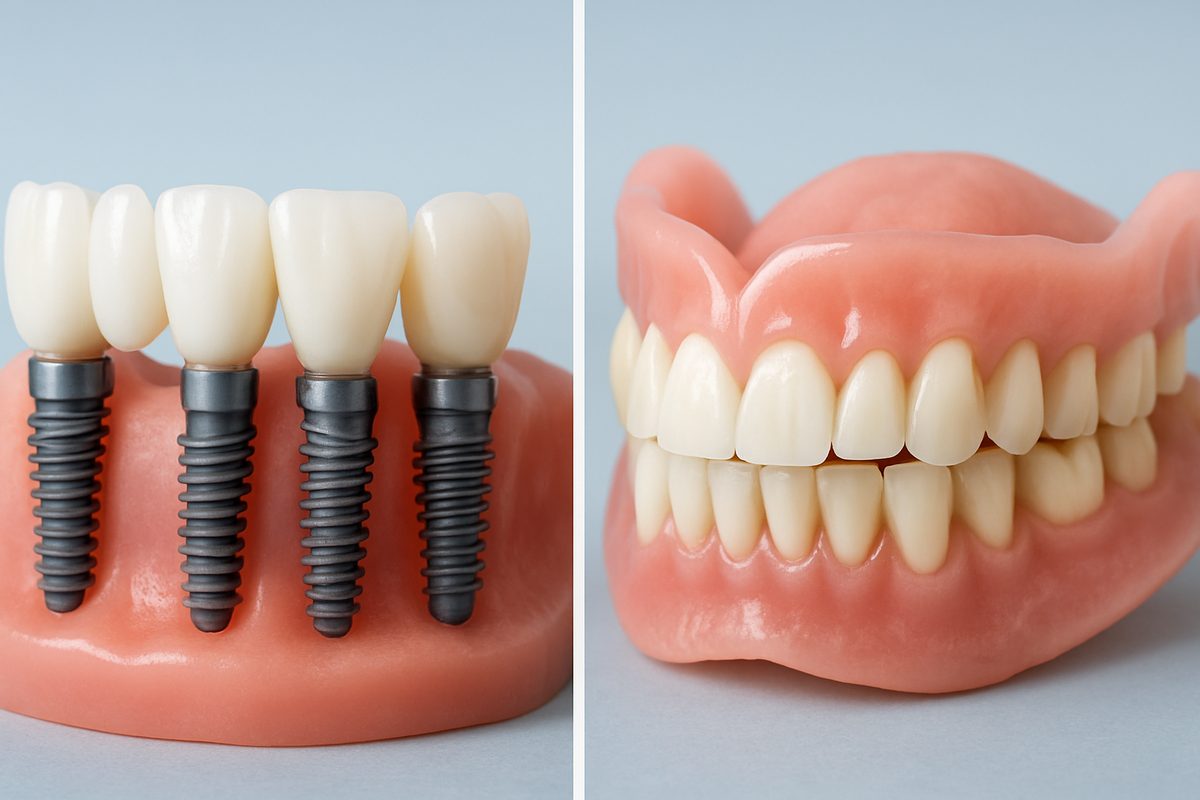
Dental implants are artificial tooth roots made of titanium that are placed into the jawbone. A typical implant restoration has three parts: the implant (the metal post), the abutment (the connector), and the crown (the visible tooth). Because implants fuse with bone, they act like natural roots. That stability makes dental implants in Leeds, Alabama a long-term option for replacing one tooth, several teeth, or a full arch.
How dental implants work
Types of implant restorations
Implants can support different restorations depending on what’s needed:
- Single-tooth implants — replace one missing tooth with a crown.
- Implant-supported bridges — replace two or more teeth when adjacent teeth are missing.
- Full-arch solutions (like All-on-4) — support a whole upper or lower set of teeth on fewer implants.
The treatment process
Most implant treatments follow these steps:
- Planning and imaging — 3D scans and X-rays map bone and nerve locations.
- Placement — the implant is surgically placed into the jaw.
- Healing (osseointegration) — bone grows around the implant for stability (weeks to months).
- Final restoration — the abutment and crown, bridge, or denture are attached.
New digital tools and guided surgery shorten the timeline and improve accuracy for dental implants in Leeds, Alabama.
Who is a good candidate for dental implants in Leeds, Alabama
Most adults who are healthy enough for routine dental surgery can be considered for dental implants in Leeds, Alabama. Key factors include:
- Bone volume — adequate bone is needed to hold the implant, though grafting can help.
- Gum health — active gum disease should be treated first.
- Medical conditions — uncontrolled diabetes or certain autoimmune disorders can affect healing.
- Smoking — tobacco use reduces success rates and slows healing.
- Age — implants work for most adults; bone growth must be complete.
Clinics use digital imaging to evaluate bone, nerves, and sinuses before recommending treatment.
Alternatives to dental implants: what are your options
Fixed dental bridges
Fixed dental bridges replace missing teeth by anchoring a false tooth to adjacent natural teeth. They work well when nearby teeth are healthy or already crowned. Pros: quicker, no surgery. Cons: healthy teeth may need shaving down, and bridges typically last 7–15 years before replacement.
Removable partial and full dentures
Removable partial and full dentures are a non-surgical option to replace many or all teeth. Benefits include lower upfront cost and faster delivery. Limitations include less stability, possible sore spots, and the need for periodic relines or replacements. Dentures are a non-surgical option to replace many or all teeth. Benefits include lower upfront cost and faster delivery. Limitations include less stability, possible sore spots, and the need for periodic relines or replacements. Dentures can be a good temporary or budget option.
Resin-bonded (Maryland) bridges and tooth retention strategies
Maryland bridges use metal or ceramic wings bonded to adjacent teeth. They are less invasive and conserve tooth structure but are best for front teeth and have a higher risk of debonding. When possible, saving a natural tooth through root canal or crown can be preferable to replacement.
Comparing dental implants vs alternatives: cost, recovery, maintenance, and longevity in Leeds, Alabama
Here are the practical differences to consider when choosing dental implants in Leeds, Alabama or an alternative:
- Upfront cost — Implants usually cost more initially than bridges or dentures.
- Long-term value — Implants often last decades with proper care, making them cost-effective over time.
- Recovery — Implants require surgery and a healing period; bridges and dentures usually need less or no surgery.
- Maintenance — Implants are cared for like natural teeth; dentures need daily removal and cleaning.
- Function and comfort — Implants offer the best chewing ability and a natural feel compared with most alternatives.
How modern technology improves outcomes for dental implants
Technology boosts safety, fit, and speed for dental implants in Leeds, Alabama. Examples include digital 3D imaging for precise planning, guided surgery that places implants more accurately, and in-house digital labs that speed restoration delivery. CEREC same-day crown systems can provide fast, well-fitting crowns, and specialized planning tools improve All-on-4 full-arch results.
Why consider Koplon Implant & Family Dentistry for dental implants in Leeds, Alabama
Koplon Implant & Family Dentistry combines decades of experience with modern, tech-driven care. The practice offers in-house digital lab work, CEREC same-day crowns, sedation options for comfort, and expertise in All-on-4 full-arch solutions. The father-and-son team provides both surgical skill and restorative care under one roof, which simplifies treatment and follow-up.
What to expect at your consultation
Your first visit typically includes a medical and dental history review, a clinical exam, and digital imaging to assess bone and tooth structure. The team will present treatment options, timelines, sedation and financing choices, and answer your questions so you can make an informed decision.
How to get started
To begin, schedule a consultation with Koplon Implant & Family Dentistry. Bring a list of medications, your dental and medical history, and any recent dental X-rays if available. After imaging and evaluation, the team will outline recommended options and next steps to restore function and confidence to your smile.